
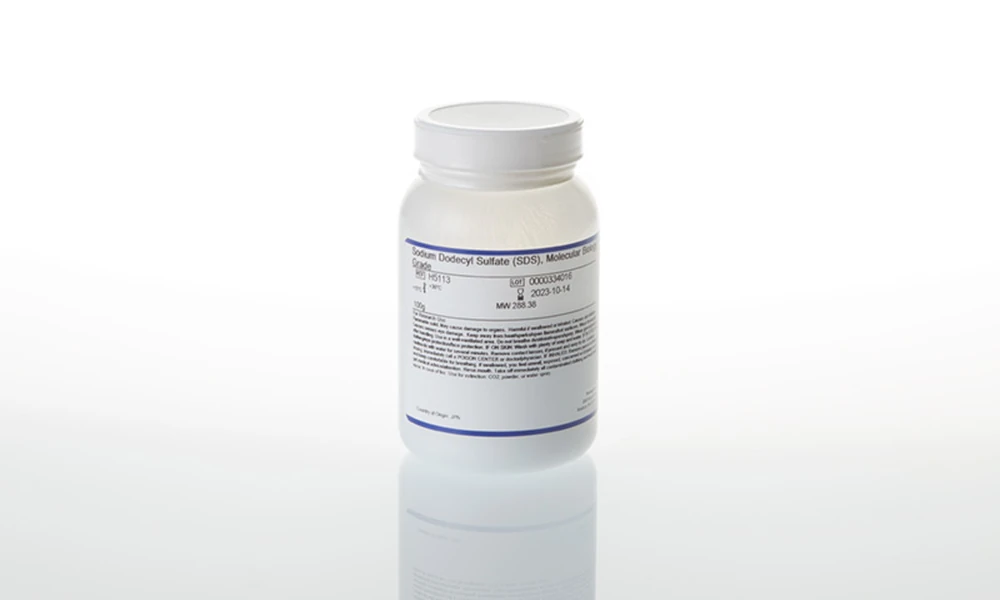
The same molecule that makes toothpaste foam sits in almost every protein lab, usually as a white powder or a bottle of stock beside the gel tanks. On a cosmetics label it goes by sodium lauryl sulfate. On the bench it is sodium dodecyl sulfate, or simply SDS. Anyone looking up the sodium dodecyl sulfate chemical by its technical name will find it described as an anionic surfactant: a twelve-carbon tail that avoids water, attached to a charged sulfate head that dissolves happily in it.
That simple two-part structure explains nearly everything SDS does. It breaks up membranes, unfolds proteins, lifts residue off glass and plastic, and causes predictable headaches when it meets cold or potassium. Knowing which behaviour you are relying on makes it easier to pick the right grade, concentration and precautions.
Why Do Proteins Separate by Size Once SDS Is Added?
A protein in its natural state is a folded shape carrying its own mix of positive and negative charges. Left alone on a gel, proteins would move by shape and charge as much as size, making molecular weight impossible to read. SDS removes that problem. When a sample is heated with it, the detergent unfolds the chain and coats it along its length, at roughly 1.4 g of SDS per gram of protein, swamping the protein’s own charge with a uniform negative one. This property makes the sodium dodecyl sulfate chemical particularly useful in protein electrophoresis, where separating proteins by molecular weight is essential.
The result is a set of stretched, negatively charged chains that all head towards the positive electrode, slowed only by the polyacrylamide mesh. Small chains slip through quickly. Larger ones lag behind. A reducing agent such as DTT or beta-mercaptoethanol is usually added too, because SDS alone does not break the disulfide bonds that hold some subunits together. The running buffer normally carries a low level of SDS, commonly 0.1%, to keep everything coated during the run.
Which Other Bench Jobs Rely on SDS?
Gels get the attention, yet SDS earns its place in quieter tasks too. In cell lysis buffers it breaks open membranes and frees proteins that milder detergents leave behind, and stronger formulations such as RIPA buffer include a small proportion of it. Plasmid preparations based on alkaline lysis use a sodium hydroxide and SDS solution to burst bacterial cells and denature their proteins before neutralisation.
Molecular biology labs also add SDS to stringency washes after nucleic acid hybridisation, where it helps cut background binding on membranes. Western blot stripping buffers pair SDS with a reducing agent and gentle heat to lift antibodies off a membrane so it can be probed again. Each of these uses relies on one trick: the tail grabs greasy surfaces while the charged head keeps everything in solution.
Does the Grade of Sodium Dodecyl Sulfate Chemical Matter?
It matters more than many students expect. Commercial SDS is made from fatty alcohols, and lower grades can carry related compounds with fourteen or sixteen carbon chains alongside the twelve-carbon one. For cleaning, that hardly matters. For protein electrophoresis, a mix of chain lengths can change how evenly proteins are coated and how sharp the bands look, so many labs keep a high-purity electrophoresis grade for gels and a general grade for everything else.
When comparing listings, the first identifier to confirm is CAS 151-21-3, which appears on every genuine product whatever trade name the label carries. Students browsing catalogue listings for sodium dodecyl sulfate Sigma-Aldrich grades will see a range that runs from general reagent up to material specified for electrophoresis and molecular biology, each with its own purity figure and impurity limits. Those details live on the certificate of analysis; keep the lot number with your records in case a strange gel needs tracing later.
Where Does SDS Fit into Cleaning Protocols?
SDS is a strong protein remover, which makes it handy for equipment that has handled biological samples. Gel tanks, combs and glass plates are often soaked or scrubbed in a dilute SDS solution to strip dried protein and stain before rinsing. Some chromatography and filtration equipment tolerates SDS washes, although the manufacturer’s compatibility guidance should settle that.
The catch is residue. SDS clings to surfaces, and even traces can upset downstream work: it interferes with some colorimetric protein assays, suppresses signals in mass spectrometry and can affect cell growth. After an SDS clean, rinse several times with purified water, and keep a separate set of glassware for sensitive analyses where space allows.
Cloudy Stock Solutions and White Crystals: What Went Wrong?
Two quirks catch out almost everyone. The first is temperature. Concentrated SDS solutions come out of solution in the cold, so a 10% or 20% stock kept in a fridge, or running buffer left in a cold room, can turn cloudy or grow fine white needles. Store stocks at room temperature and warm a cloudy bottle gently, swirling until clear, before use.
The second is potassium. Potassium dodecyl sulfate is far less soluble than the sodium form, so mixing SDS with potassium salts or potassium-rich buffers can throw a fine white precipitate. The same effect explains why some clean-up protocols deliberately add potassium salts to pull SDS out of a sample.
Which Precautions Matter When Weighing SDS Powder?
The powder carries most of the risk. Supplier safety data sheets classify SDS as a flammable solid that is harmful if swallowed or inhaled, irritating to skin and the respiratory tract, and capable of causing serious eye damage. The light particles lift into the air easily during weighing, so use a fume hood or ventilated balance enclosure, wear safety glasses and gloves, and avoid sweeping spills dry. Product pages for sodium dodecyl sulfate Sigma grades, like any other supplier’s listing, normally link the current safety data sheet, and it deserves a read before the first weighing.
Many labs limit dust by making one concentrated stock in a controlled setting, or by buying ready-made solutions. Keep the solid tightly closed, as it picks up moisture, and away from heat and ignition sources. SDS is harmful to aquatic life, so dispose of concentrated waste according to local rules instead of pouring it straight down the sink.
Is SDS Ever the Wrong Choice for a Sample?
Yes: whenever a protein must stay folded and active, as in enzyme assays, native gels or many binding studies, SDS works against you, because unfolding is exactly what it does. Milder non-ionic or zwitterionic detergents are the usual alternatives in those cases. For denaturing gels, tough lysis and protein-stripping clean-ups, the sodium dodecyl sulfate chemical remains one of the most dependable tools on the bench. Laboratories sourcing these reagents can refer to Sigma Chemicals Distributors in India when comparing available grades and supplier options. Match the grade to the job, keep stocks warm and away from potassium, and treat the powder with steady respect

Comments are closed.