
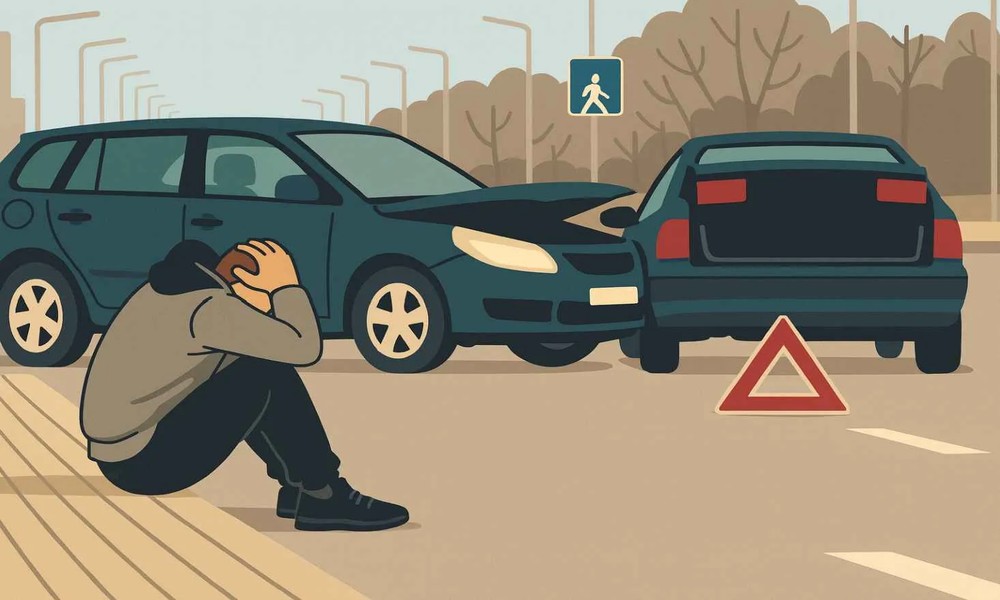
A driver swerves to avoid a car that drifts into the lane, hits the guardrail, and ends up with a serious back injury and a totaled vehicle. The other car is gone before anyone can read the plate. That is what insurance carriers and New Jersey courts call a phantom vehicle case, and it is one of the harder personal injury claims to win without the right evidence and the right approach. The Law Offices of Anthony Carbone has handled these claims throughout Hudson County for decades, and the people who walk in expecting a routine no-fault claim usually leave with a much clearer picture of why these cases require a different strategy from the start.
What a Phantom Vehicle Claim Actually Is
A phantom vehicle, in insurance terms, is a vehicle that causes an accident without making physical contact and without staying at the scene. The classic example is the driver who cuts off another car on the Pulaski Skyway, forcing it into a wall, then keeps driving. There is no license plate, no exchange of information, and often no witnesses outside of the injured driver themselves.
These cases get treated as uninsured motorist claims under New Jersey law because the at-fault driver, by being unidentified, is functionally uninsured for purposes of the injured person’s coverage. UM coverage on the injured driver’s own auto policy, or on a resident relative’s policy, becomes the source of recovery. The catch is in the proof. New Jersey law and most UM policies impose specific evidentiary requirements that do not apply to a standard accident with an identified at-fault driver.
The Corroboration Requirement
New Jersey case law and most UM policy language require corroboration of the phantom vehicle’s existence beyond the injured person’s own testimony. The leading statement of the rule traces back to court decisions interpreting the older hit-and-run statute and the modern UM endorsement. A claimant has to produce something more than a self-serving account that another car caused the crash.
That corroboration can take several forms. An independent witness who saw the second vehicle’s actions. A police officer’s observations at the scene that match the claimant’s version, such as skid marks consistent with an evasive maneuver. Dashcam footage from a third vehicle. Surveillance video from a nearby business or DOT camera. The corroboration does not have to identify the phantom driver. It just has to support the existence and the role of that vehicle in causing the crash.
A claim presented without corroboration is the easiest one for an insurance carrier to deny. A claim presented with even modest independent evidence pushes the case into a real negotiation.
How Uninsured Motorist Coverage Fills the Gap
UM coverage exists for situations like this. Every standard New Jersey auto policy includes UM by default, with limits matching the policy’s bodily injury limits unless the policyholder affirmatively reduces them. The coverage pays for bodily injury caused by an uninsured or unidentified driver, including phantom vehicle cases that meet the corroboration requirement.
Stacking household coverage matters. A driver hit by a phantom vehicle who lives with a parent or spouse carrying their own auto policy may have access to UM benefits under both policies, depending on the policy language and the order of priority set by N.J.S.A. 17:28-1.1 and the case law interpreting it. The total available coverage in a serious injury phantom vehicle case is often higher than the injured person realizes when they first call.
PIP benefits run on a separate track. The injured driver’s medical bills and a portion of lost wages are paid through PIP regardless of whether the corroboration requirement is ultimately met for the UM claim. PIP is not subject to the same proof standard, which means medical care does not stop while the liability fight plays out.
The Reporting and Notice Requirements That Trip People Up
Phantom vehicle claims have deadlines and notice requirements that other auto claims do not. Most UM endorsements require the insured to notify the carrier of the claim within a specified period, often 30 days, and to file a police report promptly after the accident. A claimant who handles a single-vehicle wreck by exchanging no information, going home, and filing a claim a week later sometimes finds the carrier denying coverage on a technical notice basis even when the underlying facts support the claim.
Calling the police to the scene when there is any chance another vehicle was involved is one of the most useful steps an injured driver can take, even if the impact only damaged their own car. The contemporaneous police report is often the corroboration that anchors the later UM claim.
How The Law Offices of Anthony Carbone Approaches These Cases
The work in a phantom vehicle case starts with a wider evidence search than most accident claims require. Pulling traffic camera footage from the New Jersey Department of Transportation through OPRA requests, canvassing nearby businesses for surveillance video before retention windows expire, identifying witnesses who may have continued driving after the crash, and locking in the police report before it gets revised. The corroboration window often closes within weeks of the crash, which is why early counsel makes such a noticeable difference in these claims.
UM negotiations themselves are different from third-party negotiations. The injured person is now in an adversarial posture against their own insurance company, and the carrier is no longer obligated to act as if it is on the same side. That shift catches a lot of claimants off guard.
The Next Step If a Phantom Vehicle Caused Your Crash
A driver in Jersey City, Hoboken, Bayonne, or anywhere across New Jersey forced off the road by an unidentified vehicle has a real claim, but only if the evidence is preserved and the policy provisions are taken seriously from the start. The Law Offices of Anthony Carbone offers a free consultation for accident victims and will walk through the available UM coverage, the corroboration evidence on hand, and the realistic path forward. Get that conversation on the calendar before the cameras overwrite and the deadlines start running.

Comments are closed.